
1917-1919: Standing up for Freedom of Speech During War
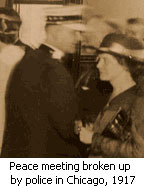
By the end of 1916 with her participation in the NAACP anti-lynching campaign and the Hughes Women’s Special, Elisabeth Freeman had established herself as a national player. She was a contender for the position of national organizer for the NAACP. Yet, somehow she ended up working to oppose the war, or at least stand for civil liberties during war time. She was a part of the Emergency Peace Federation, a coalition of groups brought together to discuss peace. This group became the People’s Council of America with regional chapters representing many thousands of activists. The People’s Council remained a coalition of diverse groups, some of which did not always agree.
- The First Waco Horror: The Lynching of Jesse Washington by Patricia Bernstein
- Letter to Louis Lochner about organizing difficulties June 17, 1917
- Flyer People’s Council
 Initially
Elisabeth was the legislative secretary, or lobbyist, of
the Council and did some effective political work, getting
hearings on conscription and civil rights at war time. She
articulated to Congressional members the principles of the
movement including the rationale for a negotiated peace, an
open debate about an exit strategy for the war, against
suspension of basic civil rights, and “no forcible
annexations of nations” as a condition of peace. But
the push to war was very strong and the situation changed
daily, and friends like Rep. Jeanette Rankin and Sen. LaFollette
(he was a supporter of striking garment workers and his
daughter Fola was a suffragist) were quickly out numbered.
Initially
Elisabeth was the legislative secretary, or lobbyist, of
the Council and did some effective political work, getting
hearings on conscription and civil rights at war time. She
articulated to Congressional members the principles of the
movement including the rationale for a negotiated peace, an
open debate about an exit strategy for the war, against
suspension of basic civil rights, and “no forcible
annexations of nations” as a condition of peace. But
the push to war was very strong and the situation changed
daily, and friends like Rep. Jeanette Rankin and Sen. LaFollette
(he was a supporter of striking garment workers and his
daughter Fola was a suffragist) were quickly out numbered.
- Lochner to Lola Maverick Lloyd on the lobbying activities of the peace movement
- Letter from Lochner “drafting” Elisabeth for the Chicago job, page 2
- EFinvite Letter inviting people to Chicago conference
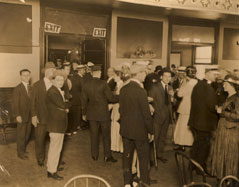 In
a very flattering letter from Louis Lochner on 6-27-17,
Elisabeth was “conscripted” to organize the
September 1st conference in the Midwest, as no one else
could pull together such an event in such a short amount
of time. In Chicago, she worked hard to create order and
to smooth relations between personalities and groups. She
tried to strike a balance between the socialists “who
did all the work” and the more moderate elements like
Jane Addams of the Woman’s Peace Party.
In
a very flattering letter from Louis Lochner on 6-27-17,
Elisabeth was “conscripted” to organize the
September 1st conference in the Midwest, as no one else
could pull together such an event in such a short amount
of time. In Chicago, she worked hard to create order and
to smooth relations between personalities and groups. She
tried to strike a balance between the socialists “who
did all the work” and the more moderate elements like
Jane Addams of the Woman’s Peace Party. - Account from Loose Leaves from a Busy Life by Morris Hillquit
- Account of Gov. Lowden’s first attempt to disband conference
- Photo of pacifist leaders and clipping of Chicago meeting. note: bannedpeace is just the photo
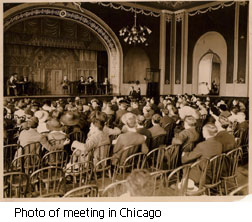 Sentiment against any who opposed the war or who were not
sufficiently patriotic, increased in the two months that
it took to organize the conference. The result for Conference
organizers was that state and local politicians played against
each other. The Minneapolis Mayor, a socialist, welcomed
them but their contract for a convention hall was canceled
at the last minute. The Minnesota governor prevented an
outdoor meeting. The Governor of North Dakota was welcoming,
as was the Wisconsin governor, but in Hudson WI a mob of
angry “patriots” escorted a planning committee
out of town. Many delegates from the East Coast were on
a specially chartered train heading to some unknown destination
“West”. At the last minute, Mayor Thompson of
Chicago gave them shelter
Sentiment against any who opposed the war or who were not
sufficiently patriotic, increased in the two months that
it took to organize the conference. The result for Conference
organizers was that state and local politicians played against
each other. The Minneapolis Mayor, a socialist, welcomed
them but their contract for a convention hall was canceled
at the last minute. The Minnesota governor prevented an
outdoor meeting. The Governor of North Dakota was welcoming,
as was the Wisconsin governor, but in Hudson WI a mob of
angry “patriots” escorted a planning committee
out of town. Many delegates from the East Coast were on
a specially chartered train heading to some unknown destination
“West”. At the last minute, Mayor Thompson of
Chicago gave them shelter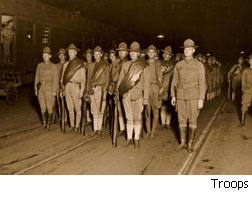 . Their
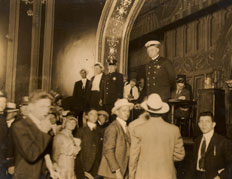
welcome was short-lived, as Gov. Lowden of Illinois moved
to break up their meeting first by ordering the police to
break up the meeting, while Mayor Thompson was out of town.
After his return, the group reconvened knowing that the
Governor would order the National Guard unit, fully armed
for battle to break up the meeting. But, the only troops
were a unit of Negro soldiers in Springfield, several hours
away, so the delegates hurriedly met and adopted a national
constitution for the People’s Council, which was adopted,
“without debate”; most unusual for a group of
radicals. The troops arrived in time to surround a wedding
which had been scheduled for the hall.
. Their
welcome was short-lived, as Gov. Lowden of Illinois moved
to break up their meeting first by ordering the police to
break up the meeting, while Mayor Thompson was out of town.
After his return, the group reconvened knowing that the
Governor would order the National Guard unit, fully armed
for battle to break up the meeting. But, the only troops
were a unit of Negro soldiers in Springfield, several hours
away, so the delegates hurriedly met and adopted a national
constitution for the People’s Council, which was adopted,
“without debate”; most unusual for a group of
radicals. The troops arrived in time to surround a wedding
which had been scheduled for the hall.
- Photo of armed troops being mustered to rout pacifists
- Full page spread on woes of peace delegates, page 2 and page 3
- Burgermeister scorn, article focuses on Mayor of Chicago
- Another account of rout of peace meeting, page 2
The media has a field day with these events, and the editorial views of the newspaper were evident in the coverage. One headline read, “all dressed up, with no place to go”; another called the Mayor “Burgermeister” in an attempt to label him pro-German. There were articles in nearly every edition stirring up war “hysteria” and encouraging anti-pacifist sentiment. Freedom of speech was an early victim of the Great War.
Article about loss of civil liberties:
- Article showing how troops would handle a domestic riot
- Alternate version of above articles
- Clipping and cartoon give flavor of anti-pacitist sentiment
Elisabeth also did extensive organizing and speaking in the Northwest in August of 1917, just prior to the Chicago meeting, with sometimes exciting adventures. The Lusk Report, an investigation of radical activities, quotes a letter from Elisabeth Freeman: “...I leaped on the table and started to speak--most of the crowd remaining....Just then eight policemen came up...and declared they would arrest me. A great shout of indignation went up but they seemed very determined.....I jumped from the table and a policeman caught my arm...People surged between us, the hand suddenly loosened and slipped into the crowd easily and back to the hall, in time to do my usual job of asking for the collection...The screws are getting tighter. ‘These are great times for democracy.’”
Another account shows a different approach: “...One has to soft pedal very much...They feared the least radical remark would upset the apple cart. I made my speech in the form of questions; and so got by with many statements... I am leaving here tonight...Will see you in Minneapolis.”
- An excerpt from The Lusk Report, 1920 focusing on Elisabeth Freeman’s organizing activities (bookex1 and 2)
- Brief article on final statement of Chicago pacifist meeting
Although the work of the People’s Council continued for the duration of the war (19 months) they were always constrained by public sentiment against criticism of U.S. policy. On a personal note, Elisabeth came to be acquainted with an illustrious crowd of radicals, including people still remembered today: Max and Crystal Eastman, Roger Baldwin, founder of ACLU, Scott Nearing, widely read by hippies for his and his wife’s back to the land lore, and others like Fola LaFollette, Morris Hillquit, Judah Magnus--illustrious at the time but largely lost to us now.
Just as notorious as her allies were her enemies. The Palmer Raids rounded up radicals and jailed them and the Lusk Report labeled any antiwar dissenters as guilty of treason. These embodied the general climate of intolerance and abuse toward even reasonable dissent and may be seen as a precursor to the House Un-American Committee (HUAC) of the 50’s, J. Edgar Hoover’s use of the FBI as a domestic spy operation, and our modern day Patriot Act.