
1916: Hughes Women’s Campaign Train
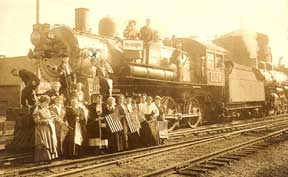 In
the presidential campaign of 1916, Charles Evans Hughes challenged
President Wilson who had not supported suffrage for women,
in spite of the demonstration at his first inaugural in 1913.
(see “hike”) Frances Kellor, who organized the
Women’s Campaign Special, was active in Teddy Roosevelt’s
1912 campaign and believed that educated women
In
the presidential campaign of 1916, Charles Evans Hughes challenged
President Wilson who had not supported suffrage for women,
in spite of the demonstration at his first inaugural in 1913.
(see “hike”) Frances Kellor, who organized the
Women’s Campaign Special, was active in Teddy Roosevelt’s
1912 campaign and believed that educated women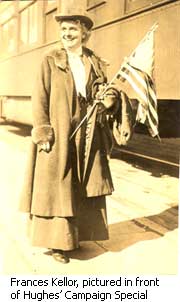 could bring their expertise to social problems. The train
was a novel way to use talented women in a political campaign,
putting to rest the notion that politics was “too dirty”
for women. Kellor contacted Elisabeth Freeman about a speaking
engagement while she was still on a speaking tour for the
NAACP.
could bring their expertise to social problems. The train
was a novel way to use talented women in a political campaign,
putting to rest the notion that politics was “too dirty”
for women. Kellor contacted Elisabeth Freeman about a speaking
engagement while she was still on a speaking tour for the
NAACP.
The “Hughsettes”
as they were sometimes referred to, made political history;
this was the first time that a party had committed to using
women in such a visible way. By the time their criss-crossing
the country was done they had spoken in 28 states, 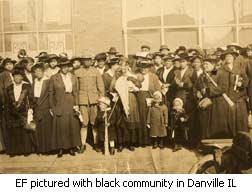 travelled
11,075 miles, and “given 1,840 speeches, indoors and
out, in circus tents, coliseums, movie palaces, and street
corners.” Kellor assembled an impressive collection
of women, balanced in terms of old guard Republicans, progressive
activists, and prominent women of the day. Notable on this
list were Mrs. Maud Howe Elliot, daughter of Juliet Ward Howe,
Mary Antin, immigrant rights worker, Mrs. Raymond Robins,
a labor leader, Dr. Katherine Davis, Commissioner of Corrections,
NYC, Rheta Childe Dorr and Ernestine Evans, journalists embedded
on the train, and Mrs. O’Shaughnessy, wife of a diplomat
to Mexico.
travelled
11,075 miles, and “given 1,840 speeches, indoors and
out, in circus tents, coliseums, movie palaces, and street
corners.” Kellor assembled an impressive collection
of women, balanced in terms of old guard Republicans, progressive
activists, and prominent women of the day. Notable on this
list were Mrs. Maud Howe Elliot, daughter of Juliet Ward Howe,
Mary Antin, immigrant rights worker, Mrs. Raymond Robins,
a labor leader, Dr. Katherine Davis, Commissioner of Corrections,
NYC, Rheta Childe Dorr and Ernestine Evans, journalists embedded
on the train, and Mrs. O’Shaughnessy, wife of a diplomat
to Mexico.
- NY Tribune article by Ernestine Evans, 11-4-16
- Speaker list from Campaign Train
- Clipping fragment describing speech by EF on Negro rights
- Clipping about speaking
to colored voters. (nd, unknown pub)
- Rocky Mountain News article on warm welcome
- Clipping of warm welcome in Iowa, after “chill” of Chicago
- Newspapers turning against campaign train; crowds less enthusiastic
Elisabeth
Freeman spoke to black audiences and also on the subject of
suffrage and labor to white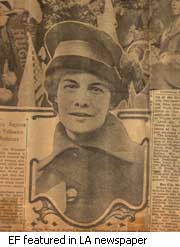 and black audiences. The train attracted huge crowds and gave
GOP women the facts and arguments to campaign for Hughes locally.
But, as the train traveled west the opposition became better
organized and met campaign events with hostile newspaper ads,
jeering, and even violence.
and black audiences. The train attracted huge crowds and gave
GOP women the facts and arguments to campaign for Hughes locally.
But, as the train traveled west the opposition became better
organized and met campaign events with hostile newspaper ads,
jeering, and even violence.
A smear campaign accusing the women on the train of being “the idle rich” thus undermining their appeal to progressives and the working class, was particularly effective and the women speakers had to respond to these accusations. In fact, the assembled speakers on the Campaign Special were from all walks of life--and work--but the epithet “The Golden Special,” for the wealth of some of its speakers, stuck to them.
- Account of “disinformation” to label Hughes personnel as wealthy, not for common man
- Members of train respond to charge of “Golden Special” being just “idle rich”
Elisabeth was featured prominently in some accounts and her proven track record in street speaking, extemporaneous oratory, and handling heckling made her especially useful. Although she spoke to black audiences and on suffrage topics, she was not above partisan jibes at President Wilson himself, accusing him of “flopping on issues.” She seemed to specially endear herself to the cowboys in Miles City Montana, two of whom corresponded with her later.
- Clipping from the Spokesman Review Oct.13, 1916, where EF led a street meeting
- EF featured in LA newspaper, Evening Express
- EF speaks at a prize fight in Billings MT
- Fragment of Phoenix newspaper: EF accusing Wilson as “flip flopping
- Account of cowboys welcoming Hughes Women
- Two cowboys send postcards to EF
- Hughes suffragettes women with cowboys in Miles City MT
Teddy
Roosevelt backed Charles Evans Hughes as did other progressives
and Woodrow Wilson  himself
thought that he might lose to Hughes, but the growing fear
of war influenced voters to vote for Wilson on the grounds
that “he kept us out of war.” In the aftermath
of the election many pundits analyzed the role of the women
campaigners in the outcome and Elisabeth herself wrote a letter
to the editor about the Hughes Women’s Campaign Special.
Frances Kellor wrote an article in the Yale Review, “Women
in the Campaign” which was re-printed as a brochure,
concluding that “women will become an increasingly important
factor in national elections...”
himself
thought that he might lose to Hughes, but the growing fear
of war influenced voters to vote for Wilson on the grounds
that “he kept us out of war.” In the aftermath
of the election many pundits analyzed the role of the women
campaigners in the outcome and Elisabeth herself wrote a letter
to the editor about the Hughes Women’s Campaign Special.
Frances Kellor wrote an article in the Yale Review, “Women
in the Campaign” which was re-printed as a brochure,
concluding that “women will become an increasingly important
factor in national elections...”