
1916:
NAACP Anti-Lynching Campaign
In
early 1916 Elisabeth Freeman was hired by the Texas Woman’s
Suffrage Association to 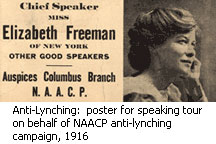 make
some inroads there. On the long train trip down to Texas, Elisabeth
met Roy Nash who was working on an anti- lynching effort for
the NAACP. The NAACP leadership felt that they needed a well
documented case of lynching to raise a public outcry about the
practice. The NAACP was founded in 1909 and needed a high profile
issue to build membership.
make
some inroads there. On the long train trip down to Texas, Elisabeth
met Roy Nash who was working on an anti- lynching effort for
the NAACP. The NAACP leadership felt that they needed a well
documented case of lynching to raise a public outcry about the
practice. The NAACP was founded in 1909 and needed a high profile
issue to build membership.
- Letter transcribed from the original from EF to her mother, on train to Texas, Jan 23, 1916
- NAACP letter from Roy Nash to EF asking her to investigate lynching in Waco, May 16, 1916
 Elisabeth
criss-crossed the state for suffrage on a contract that would
last 3 or 4 months. On May 16th, Roy Nash wrote a letter asking
Elisabeth to investigate
Elisabeth
criss-crossed the state for suffrage on a contract that would
last 3 or 4 months. On May 16th, Roy Nash wrote a letter asking
Elisabeth to investigate 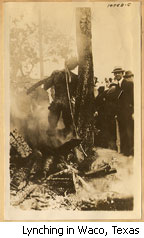 the
lynching of Jesse Washington, a young man in nearby Waco:
“Will you not get the facts for us? Your suffrage work
will probably give you an excuse for being in Waco...”
Elisabeth was on the scene soon after it happened and interviewed
everyone from the judge and sheriff to the family of the young
man as well as the family of the woman he was accused of killing.
She spent about a week there interviewing people, getting
photos of the event, and trying to locate people to protest
the lynching. She also visited black churches in town and
apologized for the behavior of whites.
the
lynching of Jesse Washington, a young man in nearby Waco:
“Will you not get the facts for us? Your suffrage work
will probably give you an excuse for being in Waco...”
Elisabeth was on the scene soon after it happened and interviewed
everyone from the judge and sheriff to the family of the young
man as well as the family of the woman he was accused of killing.
She spent about a week there interviewing people, getting
photos of the event, and trying to locate people to protest
the lynching. She also visited black churches in town and
apologized for the behavior of whites.
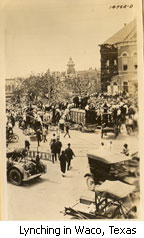
Apparently there was no real doubt about Washington’s guilt, but the fault lay in the security of the courtroom. Just after the verdict, a mob grabbed him and dragged him around town, tortured him, and burned him alive while an estimated 10,000 people watched. A photographer was forewarned and set up near the lynching site, capturing it all on film.
 This
was the perfect case for the NAACP--solid intelligence by
an outside observer, photos documenting the horror, and a
town that was not a “backwater” place, but a young
city with dozens of churches, several colleges, and a modern
outlook. The NAACP used this information to launch their anti-lynching
campaign, and to raise awareness and funds for this effort.
This
was the perfect case for the NAACP--solid intelligence by
an outside observer, photos documenting the horror, and a
town that was not a “backwater” place, but a young
city with dozens of churches, several colleges, and a modern
outlook. The NAACP used this information to launch their anti-lynching
campaign, and to raise awareness and funds for this effort.
Elisabeth used all of her wiles and intelligence to investigate the situation. She flirted to get what she wanted and bravely confronted officials and citizens alike, at some danger to herself. Her hotel room was searched twice and she herself was told to “get out of town before you are hanging on that tree.” * Elisabeth was outraged by this lynching and threw herself into this new cause. The blatant injustice and cruelty of the case fueled her keen sense of social justice. (www.patriciabernstein.com)
Her report
led to two national speaking tours on behalf of the NAACP
and its Anti-Lynching Campaign Fund and to another cause in
her career. Her work for Texas suffrage came to an abrupt
end although this may have been unrelated to her controversial
anti-lynching work. She was particularly dismayed that even
liberals seemed unwilling to bring a legal challenge against
the leaders and the officials in Waco.
- Editorial Houston Chronicle May 22, 1916, denouncing lynching of Jesse Washington
- Letter from Lindley Keasbey, a professor at the Univ. of Texas, Austin, about a lawyer to press charges against mob leaders. May 31, 1916
Her speaking
tours over the course of the summer of 1916 brought her into
new territory. (itinerary-naacp) As a suffragist she was used to coming into a town in the morning,
meeting suffrage sympathizers, speaking on the street, and
being invited to speak in the evening at a meeting or other
gathering. This same tactic was not always successful in the
Negro communities where she was trying to organize. Undoubtably
black communities were much more cautious about their organizing
efforts. Speaking events and meetings were announced by small
cards, circulars/posters, and announcements in the black press;
the NAACP also used direct mail and brochures to detail their
campaign against lynching. Still,
she managed to raise money and awareness and to get much needed
tactical information for the NAACP. She also met several members
of the black women’s movement, notably Mary Talbert,
a leader in the NAACP and the Nat’l Assn of Colored
Women, women in the National Assn of Teachers in Colored Schools,
and others.
suffragist she was used to coming into a town in the morning,
meeting suffrage sympathizers, speaking on the street, and
being invited to speak in the evening at a meeting or other
gathering. This same tactic was not always successful in the
Negro communities where she was trying to organize. Undoubtably
black communities were much more cautious about their organizing
efforts. Speaking events and meetings were announced by small
cards, circulars/posters, and announcements in the black press;
the NAACP also used direct mail and brochures to detail their
campaign against lynching. Still,
she managed to raise money and awareness and to get much needed
tactical information for the NAACP. She also met several members
of the black women’s movement, notably Mary Talbert,
a leader in the NAACP and the Nat’l Assn of Colored
Women, women in the National Assn of Teachers in Colored Schools,
and others.
- NAACP brochure for anti-lynching campaign
- Elisabeth Freeman’s report on one speaking tour
- Letter from C.R. E. Lee of the National Assn of Teachers in Colored Schools
- From E. Burton Ceruti about a cancelled date on EF’s speaking tour
- Sept. 1, 1916 edition of the Black Dispatch of Oklahoma City about NAACP speaking tour, page 2
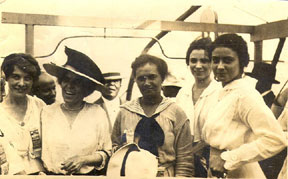 Elisabeth
seemed at ease among this new audience who admired her “pluckiness”
in investigating the lynching and speaking out about racial
injustice. Women’s suffrage groups, which were largely
white, and black organizations did not always see eye to eye,
as this exchange between two groups in Ohio illustrates: “...to
them (black men) the ballot in the hands of white women appears
only in the light of an increased number of civil and political
oppressors,” wrote a representative of the women of
the Columbus branch of the NAACP.
Elisabeth
seemed at ease among this new audience who admired her “pluckiness”
in investigating the lynching and speaking out about racial
injustice. Women’s suffrage groups, which were largely
white, and black organizations did not always see eye to eye,
as this exchange between two groups in Ohio illustrates: “...to
them (black men) the ballot in the hands of white women appears
only in the light of an increased number of civil and political
oppressors,” wrote a representative of the women of
the Columbus branch of the NAACP.
Elisabeth’s new cause did bring her to the attention of Frances Kellor, who organized the Hughes Women’s Campaign Special, as well as other more radical groups.
*Interview with Freeman’s niece, Ruth Freeman Johnston, 2004.