
London 1905 -1911: The Making of a Militant Suffragette
 Elisabeth
Freeman had returned to England with her mother, supporting
themselves by making silk ribbon flowers for nobility. She
tells the story of her conversion to the suffrage cause
this way: “I saw a big burly policeman beating up
on a woman, and I ran to help her, and
we were both arrested. I found out in jail what cause we
were fighting for.”
Elisabeth
Freeman had returned to England with her mother, supporting
themselves by making silk ribbon flowers for nobility. She
tells the story of her conversion to the suffrage cause
this way: “I saw a big burly policeman beating up
on a woman, and I ran to help her, and
we were both arrested. I found out in jail what cause we
were fighting for.” 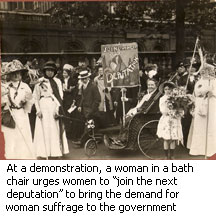
Elisabeth
found a cause that so uplifted her and saved her from the
tedium of daily life that she likened it to spirituality:
“But the supreme spirit of the militant movement is
one that, I say reverently, is not of this world. In the
great battle of Downing Street, as I looked  down
the line of marching women I saw that their faces were turned
to heaven, and there was that expression which awed and
uplifted me. It was as though the early Crusaders had been
reincarnated in them. I felt that I was watching the advance
of a mighty Christian army.
down
the line of marching women I saw that their faces were turned
to heaven, and there was that expression which awed and
uplifted me. It was as though the early Crusaders had been
reincarnated in them. I felt that I was watching the advance
of a mighty Christian army.
She
threw herself into the cause, being arrested nine times,
and eventually serving two (or more) terms in dreaded Halloway
Jail where suffragettes* went on a hunger strike and were
force fed. She earned a “medal of honor”, a
pin depicting a prison gate, and wore it proudly.
*The
WSPU took the more radical term “suffragette”
whereas the more socially acceptable term was “suffragist.”
- WSPU honored the women who sacrificed themselves by going to jail with a small pin in the shape of a prison gate with the v-shaped arrows denoting prisoners garb, image 2, image 3
- Elisabeth at a costume ball dressing as a suffragette prisoner. Note “arrows” on skirt, denoting prisoner
Emmeline
Pankhurst, with her daughters, Christabel and Sylvia and
Mr. and Mrs. Pethick 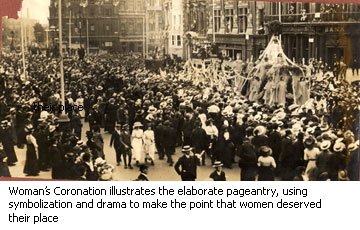 Lawrence
founded the Women’s Social and Political Union (WSPU),
a militant suffrage organization. In the English Parliamentary
system it is customary to target the Prime Minister and
the party in power to effect change. Members of the WSPU
were fiercely loyal to the Pankhursts who ran the organization
like a military operation, with escalating militancy. They
sponsored several “deputations” (large delegations
with demands in hand) to the Prime Minister or Parliament
and were inevitably met by police and arrested before getting
to the gates. The song Woman This and Woman That describes
the need for such tactics.
Lawrence
founded the Women’s Social and Political Union (WSPU),
a militant suffrage organization. In the English Parliamentary
system it is customary to target the Prime Minister and
the party in power to effect change. Members of the WSPU
were fiercely loyal to the Pankhursts who ran the organization
like a military operation, with escalating militancy. They
sponsored several “deputations” (large delegations
with demands in hand) to the Prime Minister or Parliament
and were inevitably met by police and arrested before getting
to the gates. The song Woman This and Woman That describes
the need for such tactics.
- Photo: Mrs. Pethick-Lawrence, Treasurer, (left under banner), and Christabel Pankhurst, chief strategist of the WSPU at a demonstration
- The leadership of the WSPU
- “Woman This and Woman That” is a parody and song explaining why the WSPU had to resort to their militant tactics, “with apologies to Rudyard Kipling,” image 2
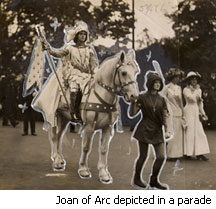 The
WSPU also sponsored huge processions and rallies with elaborate
pageantry to capture the public imagination. Eventually,
they relied on daring “stunts” like hiding a
suffragette in the rafters of a hall where there was to
be a meeting and then calling out “Votes for Women”
to the dismay of the party leaders. Their later tactics
escalated to breaking windows, setting fire to post boxes,
and other acts designed to disrupt the government until
it gave in. They finally negotiated a “ceasefire”
when England went to war with Germany; the WSPU offered
their disciplined “troops” for the war effort
in exchange for the vote after the war.
The
WSPU also sponsored huge processions and rallies with elaborate
pageantry to capture the public imagination. Eventually,
they relied on daring “stunts” like hiding a
suffragette in the rafters of a hall where there was to
be a meeting and then calling out “Votes for Women”
to the dismay of the party leaders. Their later tactics
escalated to breaking windows, setting fire to post boxes,
and other acts designed to disrupt the government until
it gave in. They finally negotiated a “ceasefire”
when England went to war with Germany; the WSPU offered
their disciplined “troops” for the war effort
in exchange for the vote after the war.
- US newspaper account of British tactics
- Letter from Mrs. Pethick-Lawrence to EF complimenting her on recruiting others.
On the envelope, EF scribbled, “I went anyway.” and “Normally, no thanks were given.”
- Letter
from EF to nieces about the origin of her wishbone ring
from Indian “princess” that she sold newspapers
with in Trafalgar Square
- Close-up and aerial shots of the American and foreign contingents of the Suffrage Parade
- American contingent including Miss Twells, EF, labelled her Miss E. Roosevelt, but otherwise listed as I. Milholland, Profs.Lillian Martin and Ada Wright of Wellesley
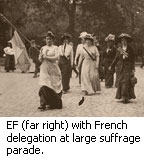
Elisabeth found an outlet for her passions and learned the
discipline and tactics of the British  suffragettes.
She went on several deputations and was arrested nine times,
according to one account. She also apparently worked hard
to engage others. She sold suffrage papers in Trafalgar
Square and organized the American and foreign contingents
at one of the large demonstrations. She also was one of
the speakers at Hyde Park. Although there is no evidence
that she got paid for her work, she gained the necessary
skills and confidence to market her abilities in the U.S.
suffragettes.
She went on several deputations and was arrested nine times,
according to one account. She also apparently worked hard
to engage others. She sold suffrage papers in Trafalgar
Square and organized the American and foreign contingents
at one of the large demonstrations. She also was one of
the speakers at Hyde Park. Although there is no evidence
that she got paid for her work, she gained the necessary
skills and confidence to market her abilities in the U.S.
 When
she returned to the America, she used her militant training
as a badge of honor and a gimmick to obtain speaking engagements
and guaranteed press coverage. She kept some connection
with English suffragettes as Mrs. Pethick Lawrence sent
her a statement for a meeting in New York City. The sacrifice
of oneself to the movement forged a new definition of femininity--genteel
yet fearless, self-sacrificing not just for husband and
children but for the uplifting of women, and by extension,
all of humanity. With this fire burning within, Elisabeth
Freeman was able to overcome a predisposition to feeling
ill, to
When
she returned to the America, she used her militant training
as a badge of honor and a gimmick to obtain speaking engagements
and guaranteed press coverage. She kept some connection
with English suffragettes as Mrs. Pethick Lawrence sent
her a statement for a meeting in New York City. The sacrifice
of oneself to the movement forged a new definition of femininity--genteel
yet fearless, self-sacrificing not just for husband and
children but for the uplifting of women, and by extension,
all of humanity. With this fire burning within, Elisabeth
Freeman was able to overcome a predisposition to feeling
ill, to  endure
all hardships, and to wax eloquent from soapbox and stage
alike.
endure
all hardships, and to wax eloquent from soapbox and stage
alike.