
1911-1916: Media Stunts for Suffrage
 By
many accounts the American suffrage scene desperately needed
an infusion of energy and starting in 1909, many English suffragettes
found a role to play in the U.S. The power structure was completely
different, however: in America, each and every voter--male
voters, except in some Western states where women had the
vote--was important and both personal contact and press coverage
were crucial to revitalizing the movement. Similar to England,
this translated to street speaking, public lectures, and pageantry.
(“forcible advertising” in London section) Elisabeth
seemed particularly adept at getting the attention of the
many newspapers in existence.
By
many accounts the American suffrage scene desperately needed
an infusion of energy and starting in 1909, many English suffragettes
found a role to play in the U.S. The power structure was completely
different, however: in America, each and every voter--male
voters, except in some Western states where women had the
vote--was important and both personal contact and press coverage
were crucial to revitalizing the movement. Similar to England,
this translated to street speaking, public lectures, and pageantry.
(“forcible advertising” in London section) Elisabeth
seemed particularly adept at getting the attention of the
many newspapers in existence.
- Letter from agent to EF, engaging her as speaker
- Brochure advertising EF as a platform speaker, part two
- Harriet B. Laidlaw, suffrage leader, recommending EF as a speaker
- Mayor calls volunteer suffrage “cranks” but the get coverage for public duty
- EF pictured with a bear: oddities get in the paper
- Account of several English militant transplants to the U.S
- Explains British tactics to Americans
 To
Elisabeth, who had gone to jail for the Cause, street speaking,
selling suffrage newspapers, and attracting the attention
of reporters and photographers were child’s play. However,
she eventually found the apathy of American activists quite
appalling. (see Woman’s J letters) As the copious press
clippings attest, Elisabeth Freeman knew how to charm “the
media” and she also managed to charm press photographers
into giving her original prints. Even when the press was against
them, she knew that suffrage was being discussed at the dinner
table.
To
Elisabeth, who had gone to jail for the Cause, street speaking,
selling suffrage newspapers, and attracting the attention
of reporters and photographers were child’s play. However,
she eventually found the apathy of American activists quite
appalling. (see Woman’s J letters) As the copious press
clippings attest, Elisabeth Freeman knew how to charm “the
media” and she also managed to charm press photographers
into giving her original prints. Even when the press was against
them, she knew that suffrage was being discussed at the dinner
table.
Elisabeth
Freeman was represented by Wm. Feakins Speaker’s Bureau
and also worked with many of the suffrage organizations of
the day, including the NYS Woman’s Suffrage Assn., the
Women’s Political Union, the National Woman’s
Suffrage Assn., The Woman’s Journal, the Texas Woman’s
Suffrage Assn., and the Congressional Union. In addition to
platform speaking, she was known for her “media stunts,” 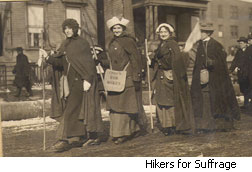 finding
some activity that would capture media attention and guarantee
press; in some cases this was an attempt to “piggy back”
onto another story as in volunteering to pick up garbage during
the NYC garbage strike and sometimes creating their own event.
On several occasions she spoke between rounds of a prize fights,
at the movies or theater, and at state or county fairs.
finding
some activity that would capture media attention and guarantee
press; in some cases this was an attempt to “piggy back”
onto another story as in volunteering to pick up garbage during
the NYC garbage strike and sometimes creating their own event.
On several occasions she spoke between rounds of a prize fights,
at the movies or theater, and at state or county fairs.
- EF arrested while supporting strikers
- Account of women strikers
- Poster about Triangle Fire protest
- Sen. LaFollette to aid strikers; EF wants to be arrested
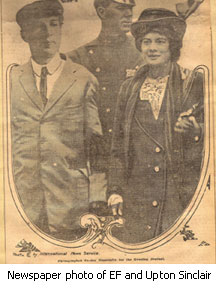
- Photos of Colorado miners and memorial service/protest at Standard Oil with Upton Sinclair
- Account of arrest of Upton Sinclair and Elisabeth Freeman, Part 2
 Elisabeth
was also an ardent supporter of women trade unionists, and
labor issues were among her speaking topics. She supported
the striking garment workers, getting arrested with them,
and was one of the speakers protesting the famous Triangle
fire, a factory that burned down with many women locked inside.
Elisabeth received a great deal of press coverage when she
protested at Standard Oil with Upton Sinclair, over the oil
company’s shooting of striking miners in Colorado.
Elisabeth
was also an ardent supporter of women trade unionists, and
labor issues were among her speaking topics. She supported
the striking garment workers, getting arrested with them,
and was one of the speakers protesting the famous Triangle
fire, a factory that burned down with many women locked inside.
Elisabeth received a great deal of press coverage when she
protested at Standard Oil with Upton Sinclair, over the oil
company’s shooting of striking miners in Colorado.
Elisabeth was involved with the NY City Suffrage Assn. when she first returned to the US and had several speaking engagements and road trips throughout the Metropolitan area. She also joined other suffragists in lobbying Albany, the state capital and later did a walking tour from NYC to Albany.
- Photo of actressesas “sandwich women” advertising suffrage play
- The World paper reports on what they wore more than what they said at NYC Suffrage Convention, 1911
- Suffrage tour in auto with Rosalie Jones
- Account of lobbying the NYS Legislature
- Hike to Albany, article 2
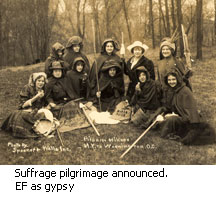
- Suffrage pilgrimage announced; EF as gypsy
- General Rosalie Jones featured as leader of hikers, Newark NJ
- Full page spread in the Philadelphia Sun showing route of march to Washington, part 2
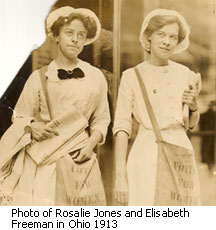
 In
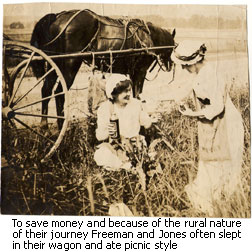
the summer of 1912, Rosalie Jones and Elisabeth Freeman took
their campaign to Ohio with a little yellow wagon filled with
literature. Said Jones, “We could have driven in an
automobile but then we wouldn’t have to stop so often”
and would miss opportunities to talk to farmers and people
in small towns. Rosalie was the organizer and Elisabeth was
the speaker for the campaign; in every town and crossroad,
she would speak on the street and try to schedule a meeting
for the evening. As in other stunts, a good deal of publicity
was given to the horse and wagon, which they named “Suffraget.”
This stunt was physically demanding and the pair frequently
slept in their wagon over night and ate their food in the
open air. In the end, the anti-suffrage forces were well organized
and Ohio did not go for suffrage.
In
the summer of 1912, Rosalie Jones and Elisabeth Freeman took
their campaign to Ohio with a little yellow wagon filled with
literature. Said Jones, “We could have driven in an
automobile but then we wouldn’t have to stop so often”
and would miss opportunities to talk to farmers and people
in small towns. Rosalie was the organizer and Elisabeth was
the speaker for the campaign; in every town and crossroad,
she would speak on the street and try to schedule a meeting
for the evening. As in other stunts, a good deal of publicity
was given to the horse and wagon, which they named “Suffraget.”
This stunt was physically demanding and the pair frequently
slept in their wagon over night and ate their food in the
open air. In the end, the anti-suffrage forces were well organized
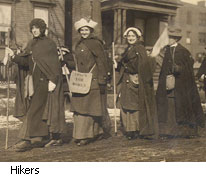
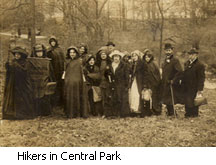
and Ohio did not go for suffrage.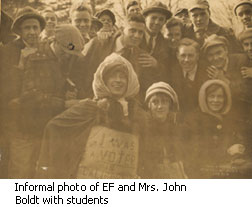 The
most arduous media stunt was the “Suffrage Hike”
or “pilgrimage” to Wilson’s first Inauguration
in the winter of 1913. Organized by millionaire heiress Rosalie
Jones, the hike coincided with a large parade that Alice Paul
of the more radical Congressional Union (of the HBO special
“Iron Jawed Angels”) was staging to confront Wilson
and Congress on the issue.
The
most arduous media stunt was the “Suffrage Hike”
or “pilgrimage” to Wilson’s first Inauguration
in the winter of 1913. Organized by millionaire heiress Rosalie
Jones, the hike coincided with a large parade that Alice Paul
of the more radical Congressional Union (of the HBO special
“Iron Jawed Angels”) was staging to confront Wilson
and Congress on the issue.
- Alice Paul
- Warm welcome by crowds help flagging spirits of hikers
- Two photos of crowds surrounding marchers: note EF in wagon several feet behind white horse, and accident about to happen in second photo
- Postcard to mother, notes strain among hikers, grumbling over press coverage
- Cold weather makes march more challenging
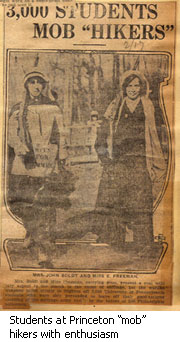
 Elisabeth
was engaged to be the official speaker on the trip and drove
the literature wagon. She was dressed as a gypsy, a traditional
follower of “pilgrimages” and she offered to read
palms and tell fortunes as a way of attracting a crowd. The
stunt garnered full page coverage in every town along the
way, but at great physical and emotional cost. The women arrived
in Washington DC exhausted and discouraged, and were a fairly
insignificant part of the giant parade which attracted sometimes
violent detractors. Still, the hikers engaged the public,
causing much excitement, especially among students.
Elisabeth
was engaged to be the official speaker on the trip and drove
the literature wagon. She was dressed as a gypsy, a traditional
follower of “pilgrimages” and she offered to read
palms and tell fortunes as a way of attracting a crowd. The
stunt garnered full page coverage in every town along the
way, but at great physical and emotional cost. The women arrived
in Washington DC exhausted and discouraged, and were a fairly
insignificant part of the giant parade which attracted sometimes
violent detractors. Still, the hikers engaged the public,
causing much excitement, especially among students.
- Hikers balk at crossing the Delaware River like George Washington due to danger of ice floes
- Anti-suffrage cleric criticizes suffrage march
- Ohio campaign clipping
- Account of difficulties in obtaining a horse and wagon
 The
C.U. differed from other, more conservative groups, by bringing
British logic and techniques to America. They eventually picketed
the White House in an attempt to hold the party in power accountable
for suffrage. This contrasted with the slow state by state
method of appealing to voters favored by the major suffrage
associations. Ultimately both methods were needed since the
suffrage amendment needed to be ratified by each state.
The
C.U. differed from other, more conservative groups, by bringing
British logic and techniques to America. They eventually picketed
the White House in an attempt to hold the party in power accountable
for suffrage. This contrasted with the slow state by state
method of appealing to voters favored by the major suffrage
associations. Ultimately both methods were needed since the
suffrage amendment needed to be ratified by each state.
- Suffragists promise reforms
- Suffragists oppose high cost of living
- Final vote count shows defeat for suffrage in Ohio
- Anti-suffrage speaker and EF at same place and time
- Postcard and clippings attest to the physically challenging conditions of the stunt
 In
1914, Elisabeth was engaged to take a horse drawn carriage
trip from NY to Boston complete with hurdy gurdy (a music
machine) to gather a crowd. The Woman’s Journal, the
oldest U.S. suffrage paper, founded by Alice Stone Blackwell
sponsored the trip. An intact correspondence with Agnes Ryan
of the Journal reveals their media savvy and political intrigue.
(Note: These letters have been transcribed to resemble actual
letters due to poor copies.) Their strategy was successful
in getting newspaper coverage, some of it bad, and some of
it chronicling their attempts to engage officials in the cause.
In
1914, Elisabeth was engaged to take a horse drawn carriage
trip from NY to Boston complete with hurdy gurdy (a music
machine) to gather a crowd. The Woman’s Journal, the
oldest U.S. suffrage paper, founded by Alice Stone Blackwell
sponsored the trip. An intact correspondence with Agnes Ryan
of the Journal reveals their media savvy and political intrigue.
(Note: These letters have been transcribed to resemble actual
letters due to poor copies.) Their strategy was successful
in getting newspaper coverage, some of it bad, and some of
it chronicling their attempts to engage officials in the cause.
Chronical letters (Note: These letters have been transcribed to resemble actual letters due to poor copies):
- letter A , page 2; letter B, page2; and letter C, page 2, page 3, page 4.
- Launching of the carrier pigeons. Note emphasis added by newspaper to Woman’s Journal, per instructions
- A humorous account of the encounter between suffragettes and Mayor, headline in rhyming verse
- A Horse “Asquith” is focal point of publicity
Elisabeth was also engaged to hike through Sullivan and Dutchess Counties NYS with an oxen team, as a paid organizer to tour upstate New York, especially centering her efforts in Syracuse NY. In 1916, she was engaged by the Texas Woman Suffrage Assn. to make a tour of that state and enliven suffrage supporters. Her impressions of the Texas scene were captured by several letters to her mother. Elisabeth left that post after investigating the lynching for the NAACP, and under contentious circumstances.