Overview
Elisabeth Freeman came to this country as a small child with
her brother John and sister (Clara) Jane, and
their mother, Mary 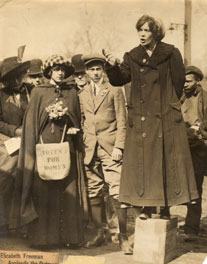
Hall
Freeman, who came estranged from her husband. Mary worked
for St.Johnland, an orphanage on Long Island for a time, and
the children lived at the orphanage for some time. Elisabeth
was far from wealthy, did not go to college, and as a woman,
her opportunities were limited. She was involved with the
Salvation Army and regularly attended meetings which she found
uplifting. Her chance encounter on a trip to England with
the British suffragettes led to a career as a professional
speaker and organizer. Her causes spanned nearly every progressive
movement in the early 20th century; she was fearless, bold,
innovative, and hard working for her beliefs. She was unflagging
in her belief that people could make the world better through
their own efforts.
Biography
1876?
Born in Chesterfield, England. Mother: Mary Hall Freeman;
father: unknown.
1880?
Came to United States as a child, attended St. Johnland School,
Long Island, N.Y.
1905-11
Worked with Women´s Social and Political Union (Pankhurst´s
organization) in England as an organizer, speaker, and coordinator
of suffrage foreign bureau.1
1911
September: returned to U.S. and worked with New York City
Woman Suffrage Party; also worked as lecturer on suffrage
and labor conditions.1
1912
Toured Long Island and Ohio in a horse-drawn wagon, speaking
and organizing for women´s suffrage with Rosalie Jones,
N.Y. “society girl”1
1913
January: arrested as picket in support of striking white goods
workers
February: official speaker on “Pilgrim´s Hike,”
a suffrage march from N.Y.C to Washington to deliver suffrage
message to incoming President Wilson.
Summer: one of four suffrage hikers to travel from N.Y.C to
Boston with a hurdy-gurdy to publicize suffrage.
Throughout the year, spoke and organized fro suffrage in N.Y.S.
1914
April: arrested with Upton Sinclair for protesting Rockefeller´s
treatment of striking Colorado miners.
Spring, summer: organizing, speaking in upstate N.Y., including
a tour by oxcart in rural areas.
Fall, winter: continued activities upstate as a paid organizer
of the NYS Woman Suffrage Assoc.1
1915
Organized and lectured exclusively in New York State.1
1916
Winter: paid suffrage organizer in Texas
Spring: investigated lynching in Waco, Texas
Summer: three month speaking tour to raise money for NAACP
anti-lynching fund.
Fall: spoke out against Wilson´s racist policies on
Hughes´ Women´s Campaign Train, on coast-to-coast
tour.1
1917
Winter, spring: organizer, speaker, lobbyist for Emergency
Peace Federation, Washington, D.C. and New York.
Summer (May, June): First American Conference on Democracy
and Terms of Peace.
June: organizer, speaker, lobbyist for People´s Council
of America, Chicago, West Coast.
Also, for rest of 19171
1918
Continued as a staff member for People´s Council and
other radical peace and labor groups.1
1919
Named on Senate Who´s Who in Pacifist and Radical Movements.
Spring: travelled to England, Scotland, and Ireland to study
labor conditions and Irish question. Victim of Red Scare,
investigated by Lusk Committee, N.Y.S., and Senate Judiciary
Committee.
1920-?
Fundraiser for Lighthouse Foundation for the blind.
1925-37
Owned and operated an antique store in Provincetown, Mass
during summers.
1930-31
Worked as Social Worker/Administrator for first food surplus
distribution during Depression.
1937
Moved to Pasadena, California for health reasons. Active in
local Woman´s Party.
1942
February: Died of pleurisy.
