Overview
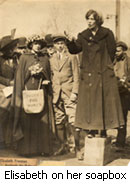
Elisabeth
Freeman came to this country as a small child with her brother
John and sister (Clara) Jane, and
their mother, Mary Hall Freeman, who came estranged from her
husband. Mary worked for St.Johnland, an orphanage on Long Island
for a time, and the children lived at the orphanage for some
time. Elisabeth was far from wealthy, did not go to college,
and as a woman, her opportunities were limited. She was involved
with the Salvation Army and regularly attended meetings which
she found uplifting. Her chance encounter on a trip to England
with the British suffragettes led to a career as a professional
speaker and organizer. Continued-
1876-1905: Early Life
Elisabeth Freeman came to this country as
a small 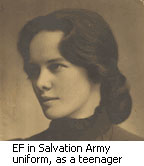 child with
her brother John and sister (Clara) Jane, and their mother
(Mary Hall Freeman) who came estranged from her husband. Mary
worked for St.Johnland, an orphanage on Long Island for a
time, and the children lived at the orphanage for some time.
Elisabeth was far from wealthy, did not go to college, and
as a woman, her opportunities were limited. Continued-
child with
her brother John and sister (Clara) Jane, and their mother
(Mary Hall Freeman) who came estranged from her husband. Mary
worked for St.Johnland, an orphanage on Long Island for a
time, and the children lived at the orphanage for some time.
Elisabeth was far from wealthy, did not go to college, and
as a woman, her opportunities were limited. Continued-
1911-1916:
Media Stunts for Suffrage
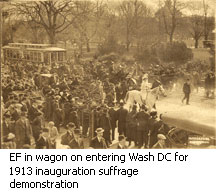
By many accounts the American suffrage scenedesperately
needed an infusion of energy and many English suffragettes
found a role to play in the U.S. The power structure was completely
different, however: in America, each and every voter--male
voters, except in some Western states where women had the
vote--was important and both personal contact and press coverage
Continued-
1916 Hughes Women’s Campaign Train
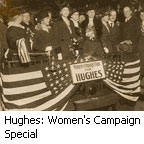 In
the fall of 1916, Charles Evans Hughes challenged President
Wilson who had not supported suffrage for women. A train carrying
an impressive array of famous women went from coast to coast
to campaign for Hughes. This was the first time women had
entered a presidential campaign on a partisan basis, even
before they were able to vote! Continued-
In
the fall of 1916, Charles Evans Hughes challenged President
Wilson who had not supported suffrage for women. A train carrying
an impressive array of famous women went from coast to coast
to campaign for Hughes. This was the first time women had
entered a presidential campaign on a partisan basis, even
before they were able to vote! Continued-
Family
life
Elisabeth
Freeman was probably born in England on
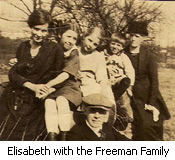
September
12, 1876, the youngest of three children. Family lore suggested
that they lived near the church with a crooked spire, which
was in Chesterfield. She came to this country as a small child
with her brother John and sister (Clara) Jane, and their mother,
Mary Hall Freeman, who was apparently estranged from her husband.
Mary worked for St.Johnland, an orphanage on Long Island when
she first came to the US, and the children lived there for
some time.
Continued-
London
1905-1911: The Making of a Militant Suffragette
Elisabeth Freeman had returned to England with her 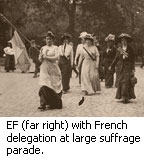 mother,
supporting themselves by making silk ribbon flowers for nobility.
She tells the story of her conversion to the suffrage cause
this way: “I saw a big burly policeman beating up on a
woman, and I ran to help her, and we were both arrested. I found
out in jail what cause we were fighting for.” Continued-
mother,
supporting themselves by making silk ribbon flowers for nobility.
She tells the story of her conversion to the suffrage cause
this way: “I saw a big burly policeman beating up on a
woman, and I ran to help her, and we were both arrested. I found
out in jail what cause we were fighting for.” Continued-
1916:
NAACP Anti-Lynching Campaign
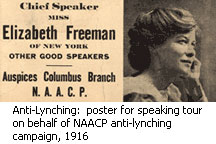
In early 1916 Elisabeth Freeman was hired by theTexas
Woman’s Suffrage Association to make some inroads there.
While there, she was contacted by Roy Nash of the NAACP to investigate
the lynching of a young man in nearby Waco. Elisabeth was on
the scene two days after it happened and interviewed everyone
from the judge and sheriff to the family of the young man as
well as the family of the woman he was accused of killing. Continued-
1917-1919:
Not even the “bad press” of the Hughes campaign
could have prepared Elisabeth Freeman for the onslaught of 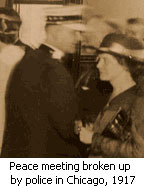 vitriol
and lies headed her way as a “militant pacifist”
before and during The Great War. Her belief in the sanity of
a negotiated peace, her disdain for the money interests of war
mongering, and her dedication to preserving civil rights for
Americans led her to work in the Emergency Peace Federation
and later with the People’s Council of America as a lobbyist
and as an organizer. Continued-
vitriol
and lies headed her way as a “militant pacifist”
before and during The Great War. Her belief in the sanity of
a negotiated peace, her disdain for the money interests of war
mongering, and her dedication to preserving civil rights for
Americans led her to work in the Emergency Peace Federation
and later with the People’s Council of America as a lobbyist
and as an organizer. Continued-
1920-1942:
Out of the Limelight, Still in the Struggle
There is no doubt that Elisabeth
Freeman’s radical life continued although the  entire
scene was muted by political and cultural oppression. However,
the record largely goes silent. We know that she worked for
a time for the Lighthouse for the Blind and during the Depression
for Emergency Home Relief in NYC, where she raged against a
bureaucracy that put itself before people, and gave potatoes
to the Chinese and rice to the Irish. Continued-
entire
scene was muted by political and cultural oppression. However,
the record largely goes silent. We know that she worked for
a time for the Lighthouse for the Blind and during the Depression
for Emergency Home Relief in NYC, where she raged against a
bureaucracy that put itself before people, and gave potatoes
to the Chinese and rice to the Irish. Continued-
